
Nutritional apps are being used by millions of people. The most popular ones provide simple calorie guidance, augmented by macronutrient advice: Water, protein, carbohydrate and fat intake. They can be connected to external data sources like activity trackers, too.
I tried three of the most popular ones in the Western world: The “granddad” of calorie counters, US company MyFitnessPal (200 million registered users) plus the European challengers Yazio (100 million users) and Lifesum (65 million users). Using all three in parallel for a week, adding my food intake to all three apps every day, every time I ate, was a pain, but the result was interesting.
While my generic daily calorie recommendations were largely similar across all apps, the way the apps dealt with activity was completely different. In Yazio, sport led to a direct increase in my permissible calorie budget via my tracker. Lifesum did not do this automatically. Lifesum built an “active life” allowance into the recommended calorie budget from the outset. But that budget did not come close to my actual estimated expenditure from my trackers. As a result, I had a consistently higher calorie budget in Yazio than in Lifesum, and the difference was huge, between 800 and 1,000 extra calories a day. That’s a whole Pizza Napoli with tomato, mozzarella and anchovies! Using Yazio was great, but I could not have survived on Lifesum’s recommended budget. MyFitnessPal, meanwhile, would not connect to my Finnish-designed fitness tracker at all (even though my tracker brand was the actual inventor of the wearable heart monitor in 1977). So much for global connectivity claims!
The point here is not this particular example of calorie-tracking apps. I suppose that if you really want to lose weight and be strict, Lifesum is the better choice. If you want to feel great about your activities and calories, use Yazio. The point is the differences in the most fundamental way the apps work. If there are huge differences in establishing something as simple as a daily calorie budget, then what about all the other nutritional recommendations?

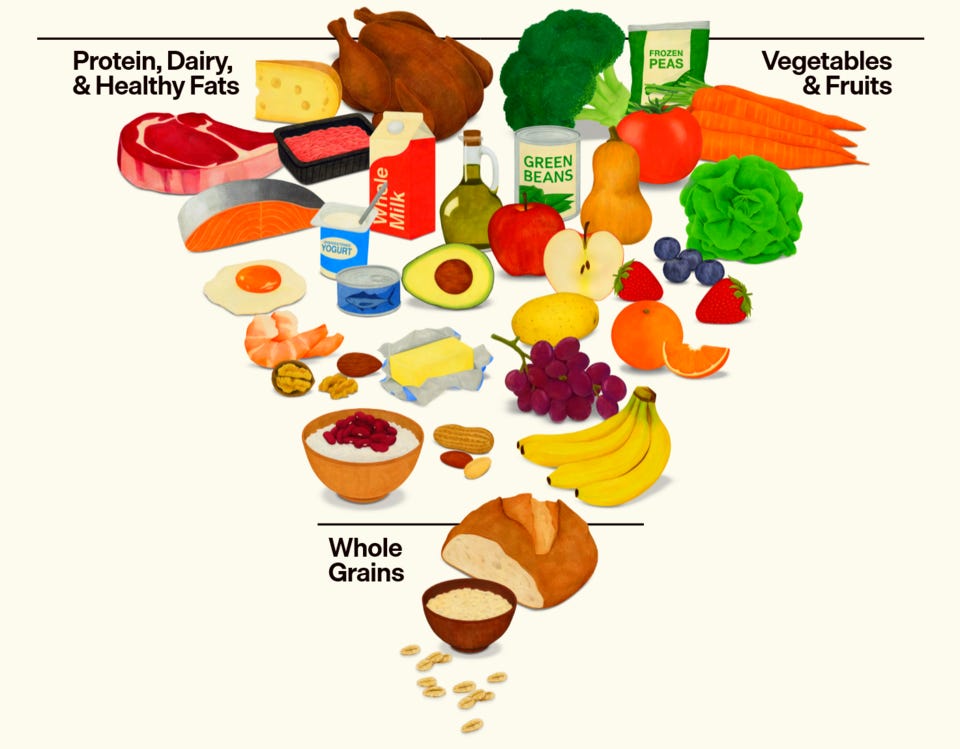
Food Pyramid, 2026, “Eat Real Food,” U.S. Government, Public domain, via Wikimedia Commons.
From a consumer perspective, this is only the tip of the iceberg when it comes to confusing guidance. How about protein intake? Should we prioritise protein as Dr. Peter Attia recommends and aim for about 2 g per kg of body weight? Or should we listen to his arch-nemesis, Professor Valter Longo of the University of Southern California, who argues for less than 1 g per kg per day? Check out this great piece from May 2025 in the blog Gene Food. The difference is huge, for me, weighing in at 75 kg, it would amount to around 300 grams of chicken (raw weight). Every day!
To go further down the rabbit hole of confusing information: Which exact protein source is best? What are possible effects of consuming too little or too much protein? Dr. Attia highlights the importance of building strength, especially when getting older. Lean red meat has a good ratio of protein to weight and, more importantly, its protein mix is rich in leucine, an important amino acid that triggers muscle growth, as well as B12 and iron. But fatty red meat is bad news for cholesterol. Furthermore, you want to trigger the enzyme mTOR to stimulate muscle growth, but not too much, since cancer growth may also be linked to it. Rapamycin is an mTOR inhibitor and actually gave the enzyme its name (”Target of Rapamycin”); it is now studied both as an immunosuppressant and as a potential longevity drug. Cancer growth is not driven by mTOR alone, but in combination with other factors, notably heme iron (abundant in red meat) and IGF-1 (which dairy tends to raise). Fermented dairy appears in some studies to behave much more favourably than milk. And kefir seems to have a slight edge over yoghurt. Plant-based proteins are the safest and most environmentally friendly sources, but to hit your protein target and a minimum of leucine for strength you need to eat a lot more beans and much more tofu. You get my point.
How do we get the right guidance for us personally? Our doctor? Attia is a physician and Longo a scientist, yet their protein recommendations could not be more different. Trainers? Nutritional advisors? All will be influenced by their own subjective preferences. AI leans more to Longo than Attia, but also because the national dietary recommendations do, too. But dare to nudge your AI into another direction and it will follow. Any of these guides might be just right for you, but they might also be just wrong.
I like the approach that German nutrition author Bas Kast used in his classic book “The Diet Compass,” which has been translated into more than 20 languages and sold over a million copies worldwide. He created a meta-level synthesis of thousands of scientific nutritional studies and arrived at a “most accepted truth” approach. I highly recommend the book, even today. But it was written in 2018, and I am not sure he could pull off now what he did then, so great has been the volume of new knowledge in nutrition since.
In the end, maybe we are left with two age-old sayings to guide us: “Everything in moderation” and “don’t eat what your grandmother wouldn’t have recognised.” While probably more useful than a lot of the influencer hype out there, these adages still won’t tell us exactly how much protein to eat. And which protein exactly is best for us. And my grandmother certainly knew what yoghurt was, but I am not sure about kefir.
We might just have to figure it out for ourselves. In the end, the best guide for the guides is ourselves.