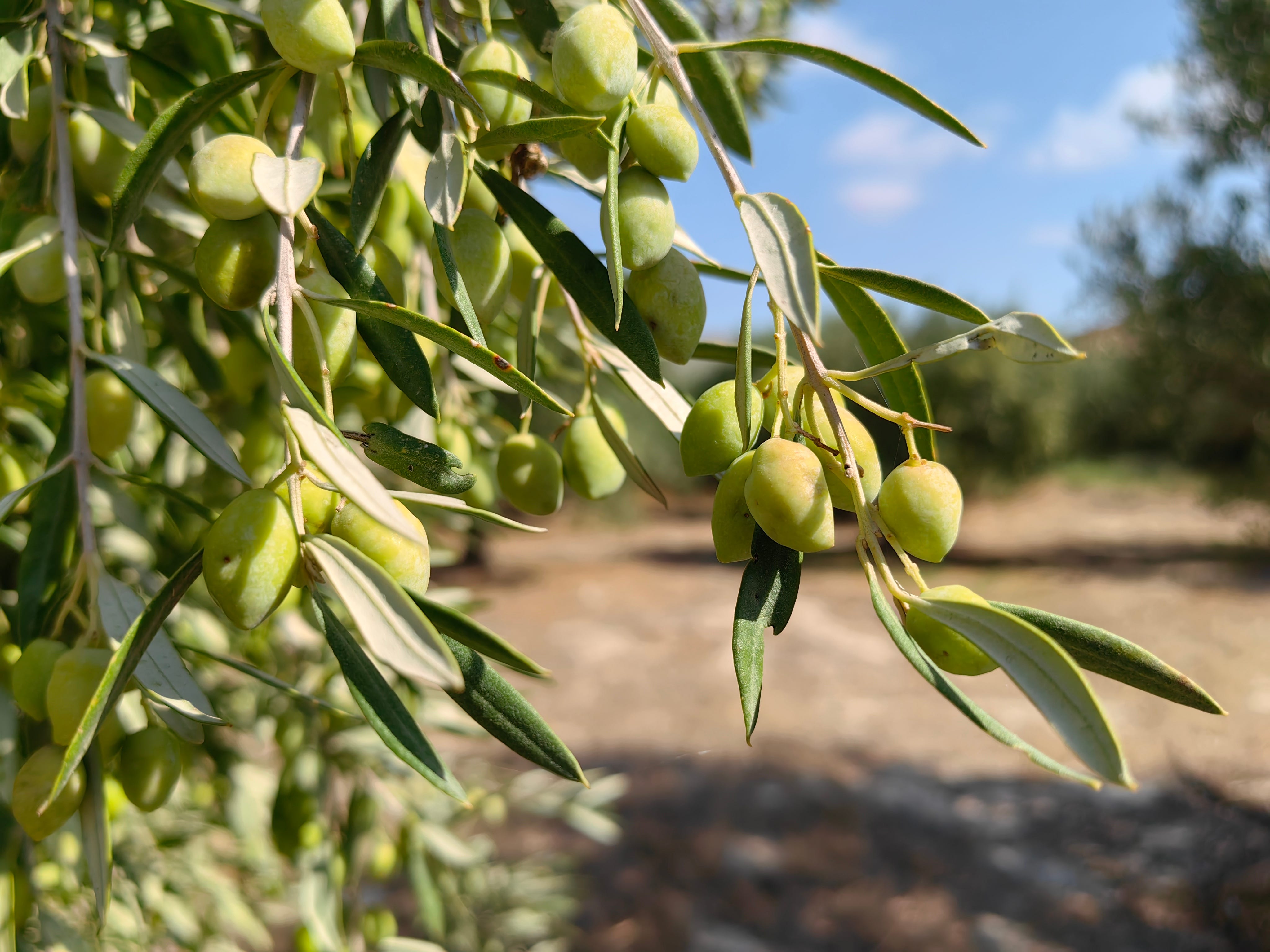

Some people call it “liquid gold:” Extra virgin olive oil, known as EVOO in the food community. It is neither a saturated nor a polyunsaturated oil. Instead, it consists almost entirely of oleic acid, which is monounsaturated. Indeed, there is a strong consensus that it may be the healthiest oil of all. EVOO also has polyphenols. These are plant-based protective agents that help the olive survive against fungi and excessive sun, as The New Scientist reports.

Photo credit: Petro Stelte, Koroneiki Olive Tree. Sitia, Lasithi, Crete. Creative Commons license.
We can break this down a little further, and if you are a food scientist, please feel free to skip this next section.
Fats 101
Contrary to common sense, fats don’t necessarily make you fat. In fact, we cannot live without fatty acids. However, how healthy fats are for you will entirely depend on the types of fat you eat.
Saturated fatty acids are found in red meat, dairy, palm oil and coconut oil. They are more solid and have higher shelf lives. However, they are known to raise your Low-Density Lipoprotein (LDL) cholesterol levels.
On the contrary, unsaturated fats are found mostly in plants and fish. More common unsaturated fats in our food are known as polyunsaturated fats, which are found both in fish and many plant-based oils. These are much healthier than saturated fats. Some of these, like oily small fish, flaxseed and rapeseed oil, contain omega-3, which is used by cell membranes and helps neurotransmitters and hormones work effectively. Put bluntly, it’s great stuff.
Most processed cooking oils consist of a blend of different fats, including both saturated and unsaturated varieties. The rise of these processed oils in cooking and food products, the so-called “trans fats”, from the 1950s onwards, is arguably one of the leading causes of heart disease in the West. Thus, the oil you choose to use in your food is hugely important to your health.
Back to EVOO, and its health impacts are astounding. In a landmark study from over a decade ago, EVOO was thought to have cut the risk of heart attacks and stroke by about 30 per cent in those most at risk.
The study, dubbed PREDIMED, was first published in the New England Journal of Medicine in 2013. It consisted of 7,447 participants, a selection of whom received one litre of EVOO a week. Principally, they were told to use at least four tablespoons of EVOO a day. The results were so overwhelmingly in favour of the olive oil group that the trial was actually broken off less than five years after it was launched, because the organisers could not ethically justify the other group not receiving the oil. Imagine that.
The study was so consequential that it developed a life of its own. A few years after its publication, methodological flaws were found in the way the data were taken. The creators then corrected the data and found very little variation in the conclusions (see The New York Times. For a full summary of the flaws and corrections, see also the NYT here).
Due to its scale, the study is still the bedrock for our understanding of the health benefits of EVOO today. A 2023 Multidisciplinary Digital Publishing Institute (MDPI) review further confirms these benefits. Moreover, our growing understanding of EVOOs’ health impacts seems to be expanding even further, including by reducing cancer and dementia risk, as per a journal taken from the National Library of Medicine and The New Scientist.
What’s holding back EVOO
Many households still do not use EVOO as much as they could because of some entrenched cooking myths. “You cannot fry with EVOO” is a falsehood, as the simple chemical structure of monounsaturated fats makes them more resilient. The only thing one should not do is heat EVOO to its smoke point. Heating to the smoke point is largely unnecessary, even for Asian dishes. Yes, my signature Pad Thai and legendary Gung Bao Chicken are fried exclusively with olive oil. Try it, I challenge you. Deep-frying, however, likely destroys some of the beneficial properties of EVOO.
The venture-capital-financed US startup Graza, known for putting olive oil in a squeeze bottle, has tried to address the limitations people perceive when cooking with olive oil by producing different types of EVOO for different cooking methods. Graza Frizzle, for example, is a neutral-flavoured, high-heat cooking oil made from a blend of olive pomace oil and extra virgin olive oil. It is designed for searing, stir-frying, grilling, and deep-frying. Notable investors include Brand Foundry Ventures (BFV), who lead Series Seed and Series A financing rounds, writing checks anywhere between $500,000 and $1.5m. Launched in 2022, the brand has grown in value to $240m, expanding into over 13,000 retail doors, including Whole Foods Market and Wegmans.
Graza tries to combat price through scale. But even still, EVOO remains out of reach for many ordinary people. A bottle of Graza starts at around $14 for 750ml, this is the oil used for cooking. Glass bottled, higher end oils from Graza are more expensive. It’s important here to note that the PREDIMED trial distributed one litre of olive oil to study participants each week.
If there is one company that has done the most to produce EVOO at the lowest possible price, it is the Tunisian CHO Group. Founded in 1996, they have grown their production steadily to ten million gallons of EVOO a year, produced by 6.9 million trees. They started as a bulk production supplier for some of the larger Italian brands and later launched their own brand, Terra Delyssa, with its characteristic horse logo. It is now one of the top EVOO brands in the USA and Canada.
Tunisia not only produces low cost EVOO, but it also leads in organic. North Africa’s climate is apparently perfect for olive growers, since they face fewer pest threats and have less need for pesticides. According to olive oil expert Isabel Putinja, two-thirds of Tunisian olive oil is organic. In fact, Tunisia has produced olive oil for over 3,000 years, associated with the proud heritage of the ancient Phoenician city of Carthage.
Newer brands emphasise the importance of quality. They focus on fastidious sourcing from selected, smaller producers, careful logistics and perfect packaging, all to retain the valuable polyphenols found in EVOO. A former German model, Elena Carrière, sells high-quality EVOO by vintage, in portions she calls “drops.” Customers are encouraged to drink 10ml of oil daily in a glass, according to her, and her co-founder Nick Mulder’s brand, Solio. The oil costs €29 for 250ml. While quality is undoubtedly important to retain some of the superpowers of EVOO, this approach does little for its democratisation.
In the UK, Citizens of Soil, another VC-financed olive oil startup, is similarly focused on quality, but at a fraction of the price. DTC subscriptions allow Citizens of Soil to make high-end oil more affordable. £15 per month buys you one 500ml pouch of extra virgin olive oil (EVOO) delivered through the letterbox. Its founder, Sarah Fulton Vachon, sources her oil from responsible, small batch producers, many of whom are female farmers. In a recent article in The Grocer, Fulton Vachon describes how she carefully selected her packaging to combine cost, shipping and preservation considerations. Citizens of Soil is backed by a group of impact-oriented VCs and family offices focused on changing consumer habits. Amongst them is FIGR, the same fund that has backed Allday Goods, a startup which turns plastic waste into kitchen tools for chefs and home cooks.
There is no doubt that EVOO is incredible. And more importantly, it should be within reach for everyone. Startups and companies are following different strategies to democratise the liquid gold. Graza has pioneered convenience in squeeze bottles, paired with specialised oils at different price points. The idea of mixing and matching different oil qualities with different price points for different purposes is sound. The no-nonsense approach of the Tunesian CHO Group, a huge agricultural producer of organic EVOO at scale, has done a lot to achieve lower prices in many retail markets. However, high quality oils that are sourced in smaller batches do better on polyphenol content. Citizens of Soil’s smart approach using a subscription DTC business model balances cost with quality. And don’t forget, even Pad Thai tastes great when made with EVOO. Regardless of the brand you use.