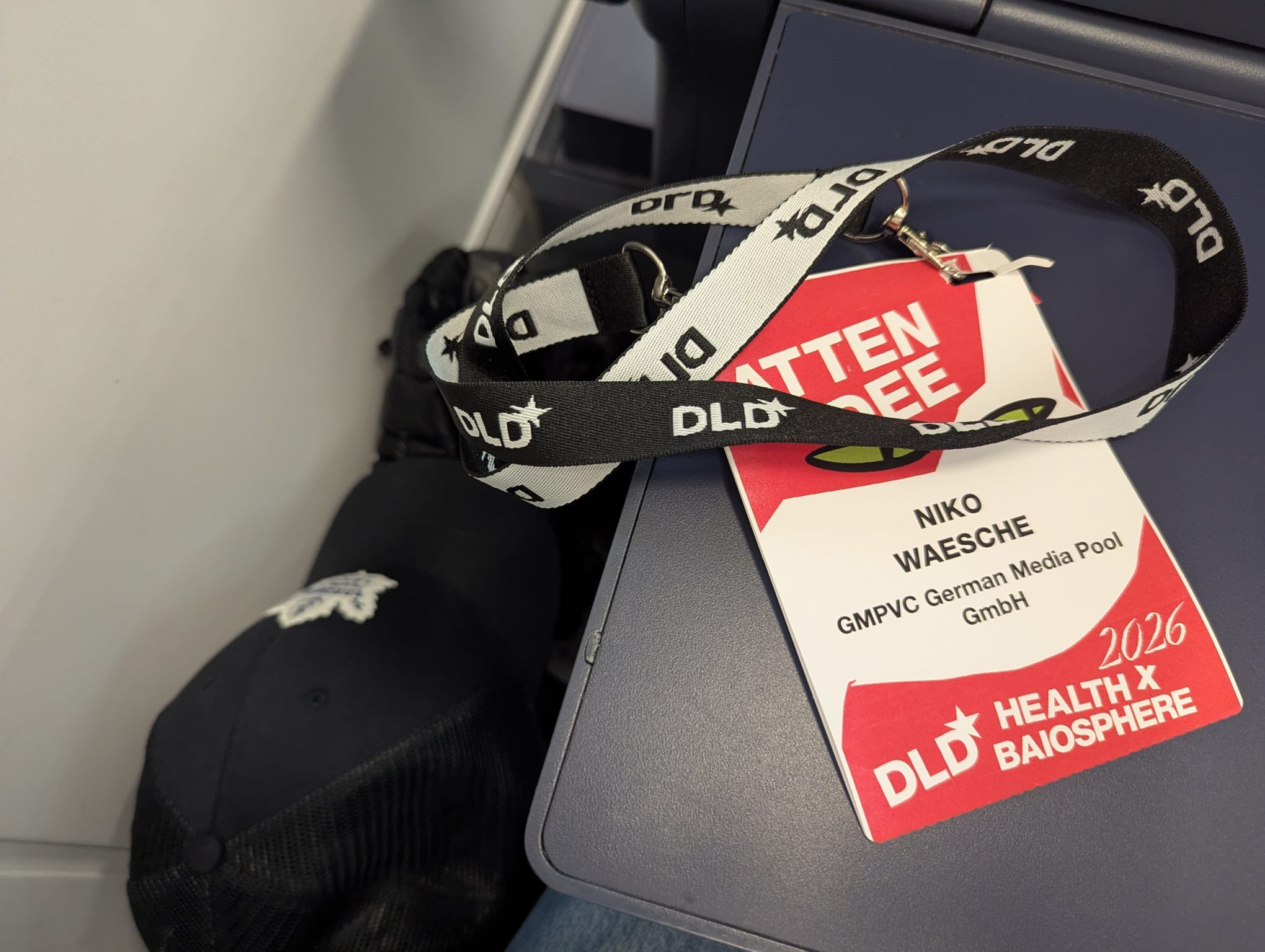

I am just on the train back home after an inspirational experience at the inaugural DLD Health in Munich. DLD Health is a new, one-day conference spin-off of the now classic DLD conference format of the Hubert Burda media group in Munich. Often, it is hard for conference spin-offs to live up to the power of the main conference, but Steffi Czerny and her co-host Alessia Sinzger managed to pull it off big time.
Two things stood out at DLD Health. One, hearing first-hand from Nobel laureate Ferenc Krausz explaining the aim of his ambitious project in preventive health. Nothing less than the democratisation of preventive health insights to fight the biggest non-communicable disease killers, with a convincing rationale to invest.
Second, the usual DLD magic of multimedial, cross-pollination of different, sometimes eclectic programme elements that make the whole more powerful than any component part. The courage to veer away from the expected and to include seemingly unfitting components is something I miss in many conferences.

Let’s start with the second reason for the success of this 2026 DLD Health. Who in their right mind would start out a conference at 9 AM — most barely had their first coffees — filled with very serious health professionals with a punk rock interpretation of Goethe’s Erlkönig? Performing in front of an incredibly beautiful graphical backdrop of what looked like microscopic cell structures, the singer laments the death of the child in his father’s arms. The same child who had warned of the dangers ahead, only to be dismissed. Maybe a warning sign for our current times, is it not, commented Steffi.
The whole day featured unexpected treats like this one, including the potential of organoid systems as a cure for pancreatic cancer — the most deadly cancer of all — all about brain-computer interfaces (including their ethics) and Google’s Fitbit-enabled capability to shift data collection from patient-measured to patient-collected. I appreciated Alessia’s comment in her introductory speech that human and planetary health go together, that fits nicely to the premise of the Black Coral Club. Also, it was an incredible treat to see one of the founding fathers of AI, the legendary Jürgen Schmidhuber, now based in Saudi Arabia, talk optimistically with a slightly mischievous grin about the magic that will happen once AI masters not only information, but the physical world, and breaks out of the computer screen to start to build things.

Ferenc Krausz presenting at DLD health today
Ferenc Krausz used the event to launch the website of an ambitious three-country predictive health research project: Protecting.Health. I did not expect a Nobel laureate’s next breakthrough to be grounded in such a deceptively simple idea. The hypothesis is the following. Most markers related to non-communicable diseases can be found in one’s blood, sometimes months or years in advance of the outbreak of the disease. The way to detect them is to take longitudinal blood samples, for example every half year, and to compare the results, not with a set of deemed “healthy” population data, but with one’s own lab result history. The underlying premise is that individual data collected over time is a much more powerful predictive indicator of disease than comparison to general population data.
The project is massive. Originally, the project started in Hungary in 2019, but it was now expanded to include institutions in Germany and Hong Kong. These institutions will collect longitudinal samples over time from 40,000 people. It is a public-private partnership, and funds investing in the project will be able to benefit from the commercial potential inherent in this huge dataset.
The original project from 2019 already resulted in initial findings:
A case of thyroid disease showed up 2.4 years earlier than clinical diagnosis.
A cardiovascular condition was visible two years before the actual condition was diagnosed.
A marker for type 2 diabetes appeared 2.3 years before diagnosis, at a stage of pre-diabetes when the disease is still reversible.
What impressed me the most is Krausz’s focus on affordability. The prediction of cancer, cardiovascular, respiratory, metabolic and neurogenic disease is to be made available for all.
This is the spirit. A spirit that was felt all day long at DLD Health.